Marshall Field's
Converted to the Macy's nameplate by Federated Department Stores in 2006.
When Federated Department Stores bought Marshall Field's and rebranded all locations as Macy's in 2006, Chicagoans protested with a passion rarely seen in retail. Not politely. There were petitions, boycotts, bumper stickers. "BRING BACK MARSHALL FIELD'S" appeared on store windows and held up at city council meetings. It was one of the most passionate retail protests in modern American history, because Marshall Field's wasn't just a store — it was Chicago.
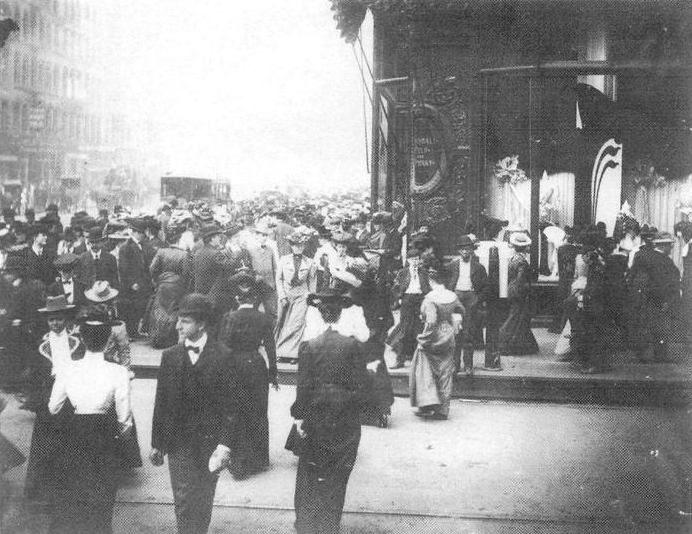
Marshall Field's grew from a Chicago dry-goods house into one of America's grandest department stores, anchored by its State Street flagship with its Tiffany favrile-glass ceiling — 6,000 hand-blown glass tiles creating a masterpiece. Landmark clocks on the building's exterior. The store built its reputation on lavish service — "Give the lady what she wants" — and on signatures like the Walnut Room restaurant and Frango mints. Shopping there felt like being welcomed into a tradition, into Chicago itself.
The State Street building itself was a destination. You went there not just to buy something but to experience the store. The holiday window displays were events. The Walnut Room could seat 500 people and served generations of Chicagoans their chicken pot pie and signature Frango mint hot chocolate at Christmas. For generations of Chicagoans, Christmas meant going to Marshall Field's to see the windows and eat in the Walnut Room. It was a ritual as important as any family tradition.
But Marshall Field's was stuck in a downtown location when shopping moved to suburbs and malls. The company expanded into suburbs, but the soul was always the State Street flagship. Other department stores invested in mall locations earlier and more aggressively. Federated (owner of Macy's) had a different strategy — consolidate, reduce costs, eliminate regional brands. When Federated bought Marshall Field's, it was a purely financial decision: eliminate a competing regional brand, merge operations, cut costs.
The Tiffany ceiling still exists — the building still stands on State Street. But it's no longer Marshall Field's. Chicagoans still resist the Macy's branding. The protests died down eventually, but the loss didn't. For a city that had defined itself partly around that store, the transition felt like an amputation. The store taught Chicago about service, architecture, and tradition. When it became a Macy's, something uniquely Chicago was lost to a corporate consolidation strategy. That's what makes the loss still sting decades later.
Known For
- State Street flagship store
- Frango mints
- The Walnut Room
- 'Give the lady what she wants'