Blockbuster Video
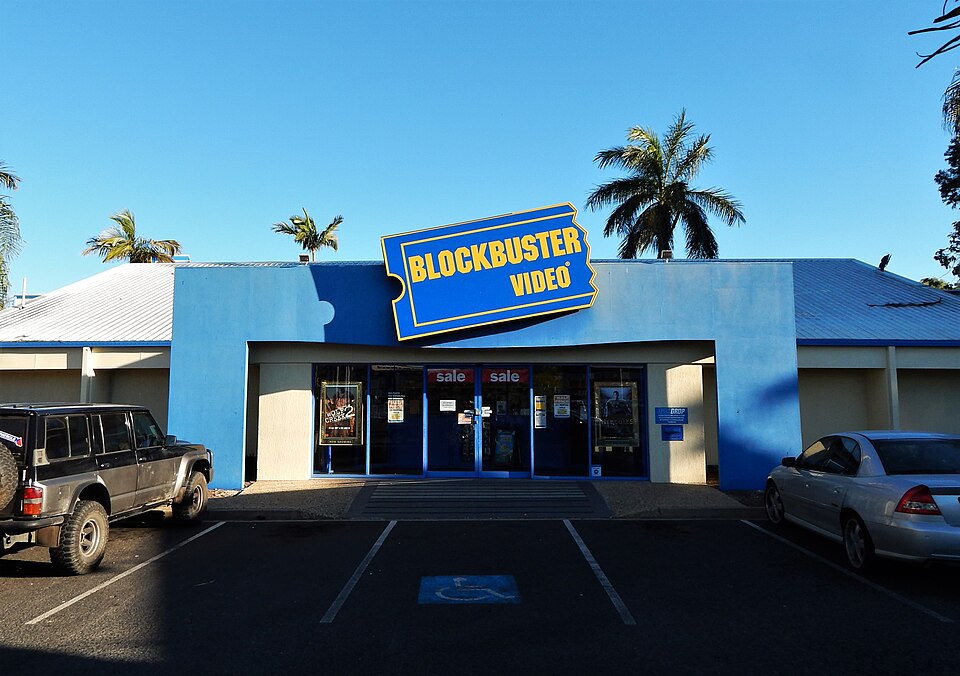
The last company-owned U.S. stores closed in early 2014; a single franchised store still operates in Bend, Oregon.
David Cook opened the first Blockbuster video-rental store in Dallas in 1985 with a radical insight: video rental didn't have to mean driving to some sweaty basement where a college kid had alphabetized everything wrong. Cook, a software engineer, saw an opportunity in standardization and scale. His store was big, organized, well-lit, and staffed by people who actually had systems. By 1990, Blockbuster had 1,000 locations. By the mid-2000s peak, roughly 9,000 stores worldwide, with over 5,500 in the United States alone. It was the largest video rental chain on Earth, by a factor of ten.
For a generation, Friday nights belonged to Blockbuster. You'd pile into the car, head to the strip mall on the edge of town, push through the glass doors, and step into what felt like a temple of choice. There was the New Release wall — the real estate every studio paid for — and it was merciless. Eight copies deep in some cases: multiple copies of the hit, arranged by genre, screaming for your attention. You'd stand in front of it for ten minutes while your friend stood six feet away saying "Just pick something," your brain paralyzed by the paradox of choice. Do you go with what you've been wanting to see, or do you take a chance on something that might be better? What if the thing your friend wants to watch turns out to be terrible and it's secretly your fault because you didn't argue hard enough?
The store smelled like carpet that had seen a million shoes and the faint mint of air freshener trying hard. The aisles were labeled: Comedy. Action. Drama. Foreign. Animated. If you wanted to seem cultured, you had to venture into Foreign or the art-house section, which was always suspiciously less crowded and somehow felt judgmental. The staff stood behind the counter — they weren't going to help you find anything, they were going to rent it to you and warn you about the late fee in a voice that made it clear they'd heard it all before.
And then there were the late fees. This is where Blockbuster's genius turned sinister. A video was due back in three days. You rented it on Friday night, it was due back Monday night. But you didn't watch it until Tuesday. Suddenly you owed them $2.50 for a VHS tape that cost the store maybe $8 to buy. This wasn't a rental fee, it was a tax on forgetfulness. By 2005, late fees accounted for a staggering percentage of Blockbuster's revenue. The company knew this, carefully calibrated the penalty to just barely feel tolerable, and built an empire partly on the anxiety and procrastination of American families. It was arguably the most successful psychological manipulation in retail history. Every Blockbuster customer carried the low-level dread of a due date, and they paid premium prices to avoid it.
Blockbuster diversified aggressively in the 1990s and 2000s. They added arcade games in the late 80s — not great arcade games, but available. They rented video games. They added a music rental section, then a music sales section. You could browse CDs and DVDs alongside videos. Some stores had concession counters with popcorn and candy. The store became a destination in a way that Netflix never did. You didn't need a computer or a streaming account; you just drove there and browsed. For teenagers, it was a hangout. You could claim you were renting a movie but really you were just wandering the aisles in the air conditioning on a summer afternoon, pretending to shop while actually just killing time.
By 2000, Netflix sent an offer: Blockbuster could acquire the mail-order DVD rental service for a reported $50 million. Blockbuster's board declined. They were too big to imagine a world in which distribution became digital, in which convenience beat out the ritual of going to a store, in which you could skip the late-fee anxiety entirely. They had 5,500+ stores generating revenue, they had location-based real estate, they had the Friday-night ritual locked down. Netflix, meanwhile, kept shipping DVDs by mail. Then streaming arrived in 2007, starting with a limited selection, then expanding to basically everything, and suddenly the entire Blockbuster value proposition evaporated in about 36 months.
Store closures began in 2007. The chain tried late. They launched Blockbuster Online to compete with Netflix, but it was halfhearted — the company's real money was still in store rentals and late fees, so cannibalizing that business felt like shooting themselves. They launched Blockbuster Express kiosks (similar to Redbox), which at least tried to address the convenience problem, but by then Netflix streaming was already the default. Blockbuster filed for bankruptcy in 2010 with $5.3 billion in debt. Store closures accelerated through 2011 and 2012. By early 2014, all company-owned U.S. stores were gone.
Except one. A franchised Blockbuster in Bend, Oregon, run by a man named Sandi Smith, remained open as a last artifact of the era. It became "The Last Blockbuster," a pilgrimage site and a meme. The store kept the blue-and-yellow aesthetic, kept the New Release wall, kept the late fees (though they were sometimes waived for out-of-state visitors), and became a tourist attraction for people who wanted to feel the 1990s one more time. It stayed open for another decade, becoming the most famous Blockbuster location ever — famous not for what it did when there were thousands of them, but for what it represented when there were none.
That Blockbuster building in Bend is the closest thing we have to a monument to that particular era of retail ritual — the Friday-night drive, the New Release wall paralysis, the late-fee dread, the browsing. Netflix is better in every practical way. But Blockbuster understood something that streaming never quite captured: shopping together, wandering, the social ritual of renting. That part of American life didn't get disrupted; it got erased. And now when someone mentions a Blockbuster, you have to be old enough to remember the experience, because your kids never will.
Known For
- The new-release wall and late fees
- The blue-and-yellow ticket logo
- Passed on buying Netflix
- 'The Last Blockbuster' in Bend, OR